Custom turning services — shafts, flanges, bushings and non-standard parts.
Turning is used to manufacture parts whose geometry is primarily formed by rotating the workpiece. ELS Systems performs turning for single-unit and series production — from manufacturing individual parts to producing batches for industrial enterprises.
Manufacturing is carried out according to the customer’s drawings, 3D models, and other technical documentation. If ready-made design documentation is not available or needs further development, ELS Systems’ own design and engineering department can join the project.
What parts we manufacture
Turning is suitable for manufacturing parts with cylindrical, conical, and other rotational surfaces. Typical products include:
shafts and axles;
bushings and rings;
flanges;
threaded parts;
machine and mechanism components;
custom parts according to the customer’s drawings.
Depending on the design, a part may require several operations: machining of external and internal surfaces, facing, drilling, thread cutting, grooving, and other elements.
The sequence of operations is determined based on the part’s geometry, material, accuracy requirements, and parameters specified in the technical documentation.
Turning from drawings and 3D models
Before production begins, specialists analyze the drawing or technical specification. Dimensions, tolerances, material, quantity of parts, surface requirements, and the intended use of the product are taken into account.
This allows the necessary operations and the optimal manufacturing method to be determined.
ELS Systems works with technical documentation in DWG, STEP, and PDF formats. If the customer only has a sketch, sample, or description of the required part, this information can also be provided for preliminary technical review.
Our own design and engineering department can develop or refine the documentation needed to start production.
Equipment for turning
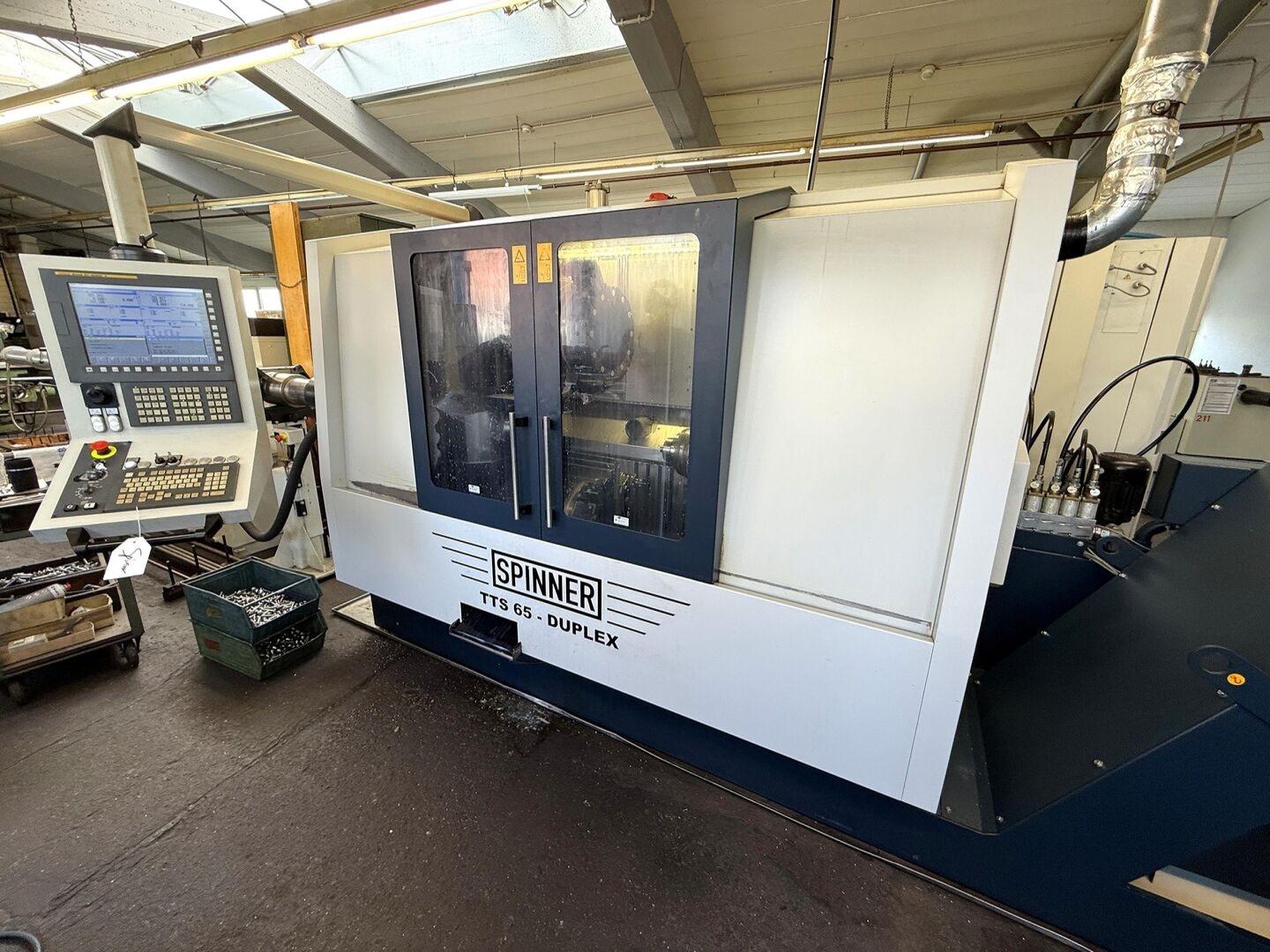
For turning, ELS Systems uses CNC equipment. Our production fleet includes the SPINNER TTS-65 Duplex / Triplex.
The choice of technology depends on the part’s design, material, required accuracy, and production volume. If needed, turning can be just one of the manufacturing stages.
ELS Systems has its own production facility and can combine different technologies within a single project. After turning, a part can be passed on to milling, laser cutting, welding, painting, or assembly.
This approach is especially convenient for industrial customers who need a finished part, assembly, or component rather than a single production operation.
Manufacturing shafts, bushings, and flanges
Turning allows us to manufacture both standard components and custom parts according to individual technical requirements.
Shafts and axles can have several mounting sections, grooves, recesses, holes, or threads. For such parts, it is important to ensure the specified dimensions and relative positioning of the working surfaces.
Bushings and rings are manufactured taking into account external and internal diameters, length, tolerances, and fit requirements.
Flanges may include a central hole, mounting surfaces, and fastening holes. Their parameters are determined by the part’s purpose and the corresponding technical documentation.
Custom parts are manufactured according to the customer’s individual drawings, 3D models, or technical specifications.
Materials for turning
ELS Systems works with a wide range of metals, including carbon and stainless steel, aluminum, and other non-ferrous metals.
Each material has its own machining characteristics. During production preparation, we take into account the mechanical properties of the metal, surface requirements, processing modes, and the characteristics of the finished part.
Accuracy and quality control
Different surfaces of a single part can have different tolerances. Mounting surfaces and other elements on which the operation of the finished assembly depends are especially important.
That’s why manufacturing is based not on an abstract “maximum accuracy,” but on the specific requirements of the drawing or technical specification.
Depending on the design and processing technology, accuracy in the IT6–IT8 range can be achieved. Production takes into account tolerances, fits, roughness requirements, and other parameters specified in the documentation.
Finished parts undergo quality control according to the agreed requirements.
Single-unit and series production
Turning may be needed both for manufacturing a single part and for producing regular series batches.
Single-unit production is relevant for equipment repair and restoration, replacing worn components, and manufacturing prototypes or custom parts.
Series production is suitable for enterprises that need a defined quantity of identical parts with repeatable parameters and stable quality.
ELS Systems is primarily focused on industrial B2B orders and can perform both individual production operations and integrated projects.
Turned parts manufacturing in Ukraine
If a company needs turned parts, it’s important to consider not just the availability of turning equipment, but also the ability to work from technical documentation, ensure the required accuracy, and carry out further production operations.
ELS Systems combines its own production facility with a design and engineering department, so turning can be performed as a standalone service or as part of integrated manufacturing.
If needed, after turning, a part can go through other operations within a single production project.
How to order turning work
To get a quote, send a drawing, 3D model, or technical specification. It is also advisable to indicate the material, the required quantity of parts, and any special requirements for accuracy, fits, or surface quality.
ELS Systems specialists will analyze the task, determine the necessary process, and prepare a manufacturing proposal.
You can order a single turning operation, a single part, a series batch, or hand over an integrated production task.
Send us your technical specification — ELS Systems specialists will assess the feasibility of manufacturing and propose the optimal production option.
Related Services
Turning is often combined with other production operations — everything can be ordered within a single production cycle:


 Machinery and Equipment


